—
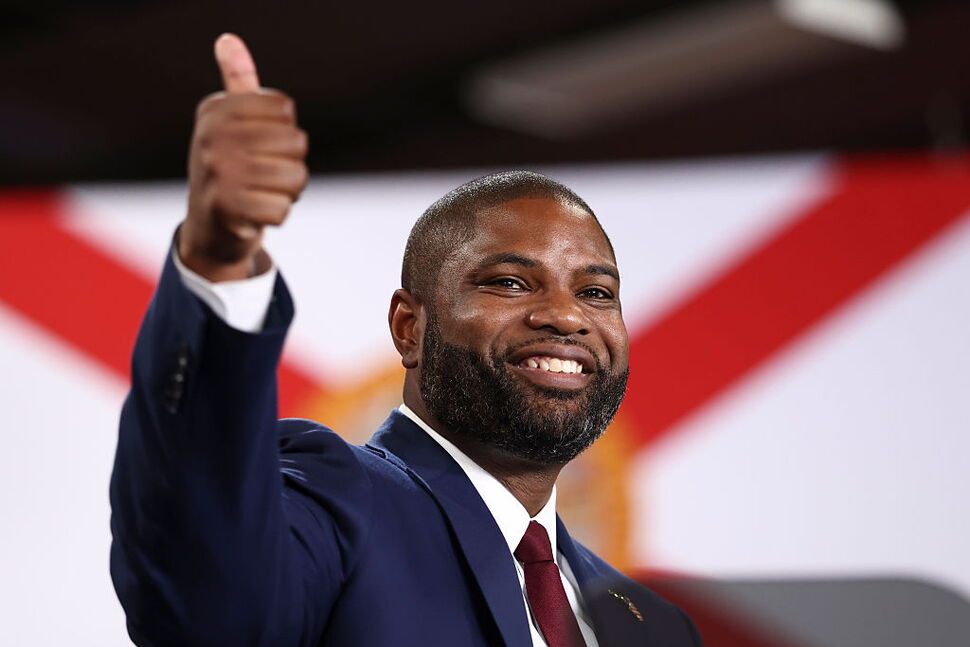
Republican Byron Donalds, flush with campaign cash and carrying President Donald Trump’s endorsement, stands a good chance of being elected Florida’s first Black governor on Nov. 3.
Make Your Inbox Smarter
Sign up for these free email newsletters from U.S. News:
Pick Newsletters
It just doesn’t seem that most Black voters support him. In fact, polls show that Democrat David Jolly, who is white, is likely to get the majority of Black votes for governor.
Two-term incumbent Republican Gov. Ron DeSantis cannot run again because of term limits. He has endorsed Donalds to replace him, after Donalds prevailed in a GOP primary battle against white opponents.
A Black supporter of Jolly, state Rep. Ashley Gantt, said at a recent opening of one of his campaign offices that skin color is not the most important asset for Black voters.
“There is a phrase, ‘All skin folk ain’t kin folk,’ which means that just because he’s Black doesn’t mean that he has a Black agenda, or he even addresses the actual needs in the Black community,” she said.
Donalds, a member of Congress from the Naples area, has been actively courting Black voters, his campaign says. One reason is that his support among whites in the most conservative counties is not that strong; Donalds lost 17 Florida counties to white opponents in the August Republican primary.
“There is also the possibility that some white Republican conservatives may not vote for Donalds because he is Black and because he is seeking to get Black votes,” said Aubrey Jewett, political science professor at the University of Central Florida. “So the possibility exists that Donalds might do a little better among Black voters but a little worse among white Republican voters.”
At a recent forum at Florida A&M University – a historically Black school Donalds once attended – he told students to be open-minded and questioned whether Blacks should automatically support Democrats.
“I’m just going to be blunt: Stop moving like a monolith,” Donalds said at the event. “Since 1963-ish, Black people have largely supported the Democratic Party. Have they actually done all the things they promised? You’ve been faithful to that party, have they been faithful to you?”
That resonates with some Black people, including Cynthia Chestnut, a Gainesville city commissioner who endorsed Donalds.
“Black voters are not political property,” Chestnut said in a statement.
Her view is in the minority, according to recent polls. A Mason-Dixon Polling & Strategy survey of 625 registered voters from Sept. 28-Oct. 1 showed Donalds with 10% of the Black vote, with Jolly getting 76% and 14% undecided. The poll has a margin of error of plus or minus 4 percentage points.
Another factor is the U.S. Senate campaign by state Rep. Angie Nixon, who is Black and part of the Democratic Socialists of America. She’s running against Republican Sen. Ashley Moody, who was appointed by DeSantis after Marco Rubio became secretary of state.
While Moody is expected to win, Nixon is likely to draw Black votes that could lean Jolly’s way especially in a midterm election cycle where Democrats appear to have the upper hand nationally.
Aside from the Trump endorsement, detractors point to Donalds’ record in Congress and the state Legislature before that. For example, he opposed a voting rights bill named for civil rights icon John Lewis. He voted against expanding voter registration and against a bill protecting against discrimination involving hairstyles popular among Blacks, including cornrows and Afros.
Jolly, a former Republican member of Congress who switched to the Democrats, isn’t taking the Black vote for granted, either. He recently appeared on the Roland Martin “Unfiltered” online program popular among Blacks and said Donalds’ plans do not reflect that community.
“The agenda is an anti-Black agenda,” Jolly said. “We have to reach voters everywhere.”
That is a challenge for Jolly, given the huge disparity in campaign funds between them. As of Sept. 25, Donalds had raised more than $134 million and spent about $91 million, according to state records. Jolly, meanwhile, had raised almost $17 million and spent $11.2 million.
Jolly said he has a shot at winning – that same poll showed him about 7 points down in a state essentially ruled by Republicans for decades – but cannot in an expensive media market state like Florida without more money from the Democratic Party and its supporters.
“I’m begging for help,” Jolly said.
The notion of electing the first Black governor of Florida is not enough to sway most Black voters away from the Democrats, said Sean Freeder, director of the Public Opinion Research Lab at the University of North Florida.
“I think one reason why Donalds is trying to convert Black voters is because he has a real problem with his own base among white rural voters, and young white men,” Freeder said. “I think he’s trying to see if newly converted Black voters can replace some white rural voters in his coalition. It’s very, very unlikely to work well.”
Then there’s the Trump factor. Although the president did better among Black voters in 2024 than most Republicans, a clear majority oppose most of Trump’s policies and identify Donalds as part of that agenda. Donalds revamped his campaign website to de-emphasize the Trump endorsement, but he’s been closely linked to the president for years.
“He can’t unring that bell now,” Freeder said. “The Trump association will follow him for the foreseeable future.”
For his part, Donalds insists his agenda is based on creating opportunity for people of every race without the heavy hand of government directing everything.
His campaign has a Black outreach director, Janiyah Thomas, who did similar work for Trump in Florida. In an email, Thomas said Donalds has made connecting with Black voters a top priority. She noted that he has a coalition of Black leaders, including pastors, business owners and young people to carry his message and has frequently visited barbershops, cigar lounges and small businesses.
“Every voter in Florida matters to this campaign, and that absolutely includes Florida’s Black voters,” Thomas said. “Byron is not taking a single vote for granted. The work he has put in from the beginning will be reflected on Nov. 3.”
Being a Republican does not equate to being anti-Black, Donalds said at the Florida A&M event.
“I don’t support discrimination. I don’t support racism. I don’t support bigotry. I don’t support antisemitism. I denounce all of that,” Donalds said. “But we also have to have a market system based upon opportunity and merit and achievement. And if you have that, what ends up happening is people with real skills have the ability to excel.”